As I talk with people about their publishing program, I often hear people apologizing for their books. Recently, in a letter about a debut book, an author wrote:
Dear Sir:
My self-published book, XXX, comes out next month. I’ve worked hard to make it a great book. Could you please take a look?
Um, no. Mentioning “self-publishing” is unnecessary. Instead, you have a great book coming out.
Indie Kids Books is a reader-supported publication. To receive new posts and support my work, consider becoming a free or paid subscriber.
“I’ve worked hard to make it a great book.” Professionals assume hard work to make a great book, this gives no useful information. Instead, it shows off your insecurities—and emotions.
“Could you please take a look?” This comes off as begging for support.
When you contact anyone about your book, you should start with your strengths, not your weakness. Communication should come from your publishing company, not your personal email as a “self-published person.”
The Curse of the Imposter Syndrome
When you start letters like this, it’s usually because you have the Imposter Syndrome. “You’re an imposter,” your worst self tells you. You aren’t really a good writer, and this isn’t really a good book. You just tried, and it’s what you could do at the time, and you know that it’s not really a great book, but maybe it’s a great book.
Stop, already!
If you reached the point of launching a children’s book into the world, you are NOT an imposter! You ARE a children’s book author, and the book is great. If it’s NOT great, then go back and revise and fix it until it is great.
OK. You’re a great author and you have a great book. How to start that promotional communication?
Promotional Communication
From your company’s email system or using your company letterhead, let’s start again.
Dear Mr./Ms. XXX (you looked up the shopkeeper’s name, so it’s not a generic Dear Sir):
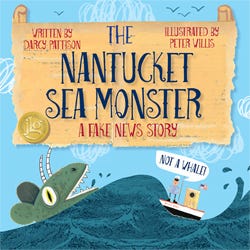
Mims House Books is excited to announce the release of The Nantucket Sea Monster: A Fake News Story, written by the award-winning author Darcy Pattison. (Your company is pitching the book. Include any awards, reviews, etc. Lead from strength!)
(Here’s a review quote.)
Kirkus Review: “. . . the wry, playful delivery . . . keeps things entertaining, brilliantly inviting discussion about hoaxes while remaining kid appropriate. . . A thought provoking story with timely resonance.”
(I always try to include a small cover file. Children’s books are very visual and it’s a useful cue.)
BLURB follows (Short, one-paragraph blurb)
Do you believe everything you read in the newspaper?
Early in August 1937, a news flash came: a sea monster had been spotted lurking off the shore of Nantucket Island. As eyewitness account piled up, newspaper stories of the sea monster spread quickly. Across the nation, people shivered in fear. This is a true (It really happened!) fake-news story.
I’d be happy to send a review copy or answer any questions. (Offering a review copy is professional, as is the offer to answer questions. This is the Call to Action, or CTA, the think you want the person to DO. Include a clear CTA in every communication.)
Thanks,
XXX, Publicity (The publicity department of your publishing company, even if it’s just you, is one way to handle this.)
MimsHouseBooks.com (Include your company website so they can look you up if they want more info.)
If you’re feeling like an imposter, acknowledge those emotions. We all feel it at some point. There have been many days when I want to hide from the world and not risk putting a book into the hands of strangers. But I do it. Unapologetically.
Don’t write a promotional letter from the point-of-view of the Imposter Syndrome. Instead think about your audience and what they want to know about your book. Find the strongest thing about the book (review, award, track record of the author, research for the book, strong writing, unusual illustrations, etc.) and focus on that.
The business communication is just to get you in the door, to get them to request a review copy. Put your best foot forward.
Indie Kids Books is a reader-supported publication. To receive new posts and support my work, consider becoming a free or paid subscriber.


Thank you for these tips, Darcy! I feel empowered and this is perfect timing!😉