

Last week, I was privileged to co-teach with Leslie Helakoski at Boyds Mills (formerly Highlights Foundation) a class on writing picture books.
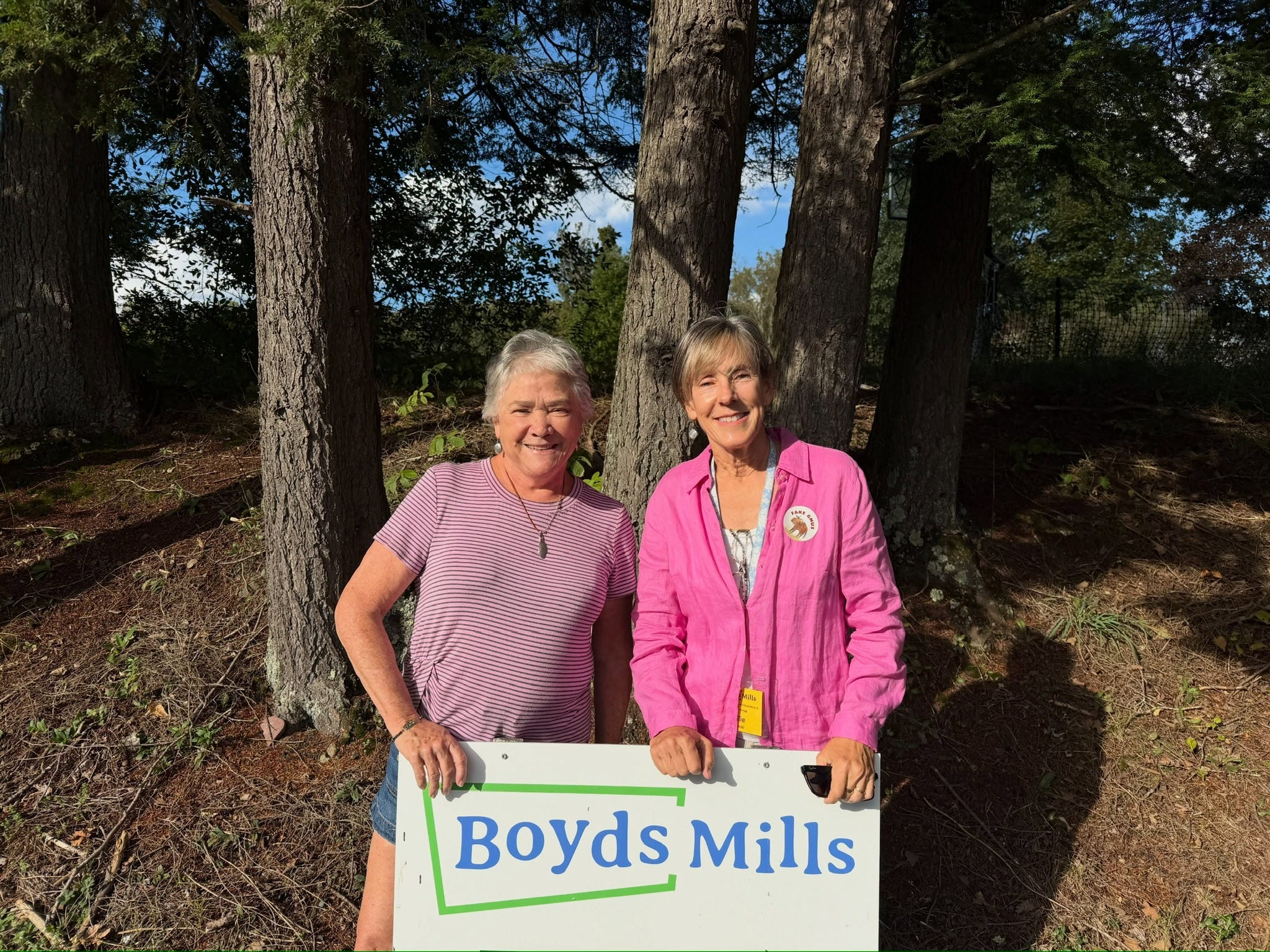
We spend the weekend talking about how to write a children’s picture book. See my book, Write a Kid’s Picture Book. We’ve taught this class over ten years and each time, I learn anew the basics that make picture books work—and sell.
This year, one thing stood out over and over: the heart of the story. Some writes already knew the structure of picture books: 32 pages, which means divide your text into about 14 double page spreads and check that each page, 1) advances the story, 2) has an action to illustrate, and 3) makes the reader want to turn the page.
Leslie likes to talk about the theme of the story by asking, “What is the about about?” By that, we mean what is the theme of the story and does it go even deeper to a heart tug in some way?
Sometimes this is obvious. In my story, Finding Courage, the title gives it away. The main character asks everyone in the neighborhood, “What is courage?” in an attempt to help her Dad learn to walk again.

Still, even when the theme is obvious, there needs to be a heart-throb moment when the reader feels emotion in some way.
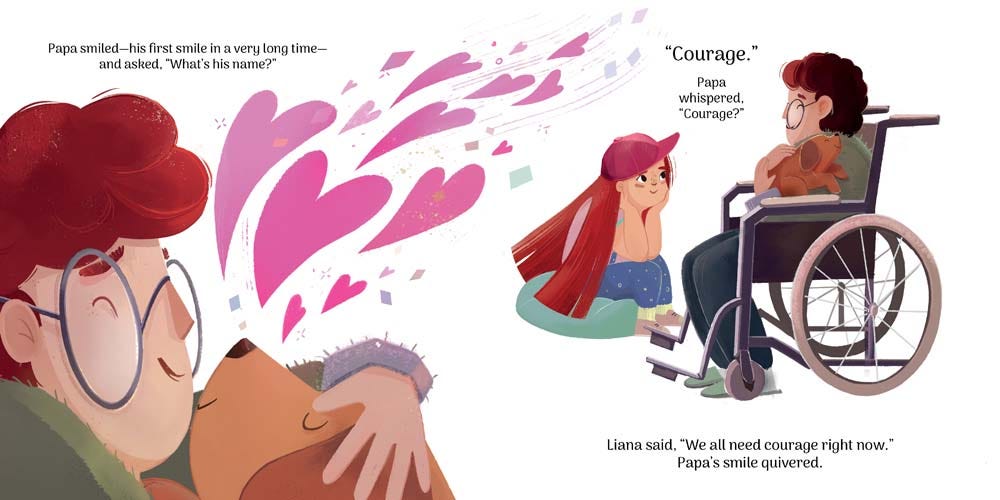
This spread brought home the idea in a personal way. After Liana has explained courage in multiple ways (inspired by the neighbors), Papa must decide if he will take courage and work with a physical therapist.
OR, in my story, JEREMY, THE ENGLISH GARDEN SNAIL, a nonfiction story about a snail, here’s the heart-felt moment.
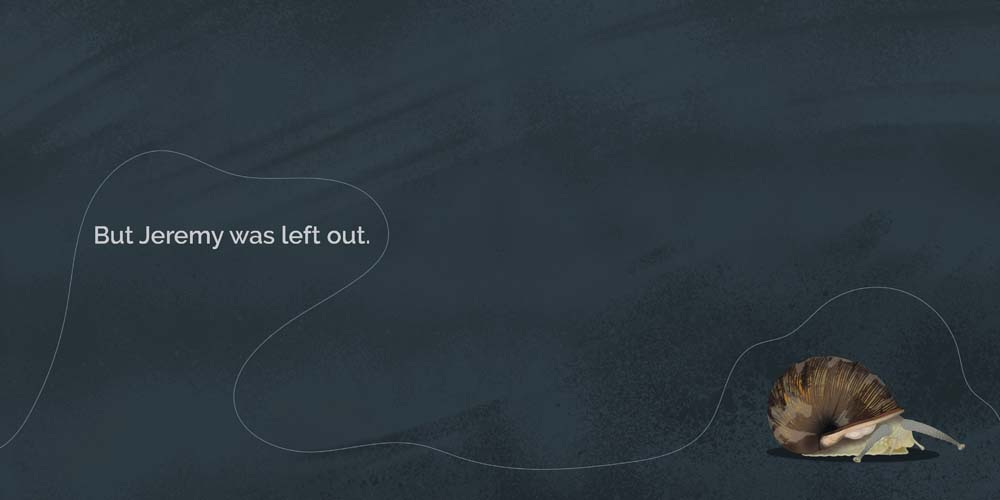
Science teachers have told me that this moment, the lonely snail, made them root and cheer that Jeremy would eventually find a mate. It was an emotional moment.
Here’s the thing: stories without the “about about” or the theme or the heart-throb moment don’t sell. Oh, yes, they sell, but not as well as other stories. In “today’s crowded market,” manuscripts without the About-About don’t get acquired by publishers and if you self-publish, they sell less than your other titles.
It’s hard to find that moment sometimes. If you wrote a story about climbing a hard mountain and a friend helped you make it, the story could center on 1) the challenge of climbing a mountain, 2) the internal struggle to not-give-up, or 3) the kindness of the helpful friend. A story like this could be technically well-written. There’s a challenge, a series of struggles to overcome, an exciting climax. You could write it in less than 500 words. But the story could still fall flat.
When that happens, I ask the author, what is the heart of the story—for you? If you had to change everything but one thing, what would that be.
Here’s a silly example. Once, a group of author was talking about coming up with stories. Rick said, “It’s easy. Stories are everywhere. For example, I’m looking out my door right now and I see a ladder leaning against a wall. You could take that ladder and write a story.”
“Rick,” I asked, “can I borrow your ladder?”
”Take it,” he said generously.
I wrote a story—that didn’t work. Critique partners said get rid of the ladder and do such and so. But—for me, and only for me—the heart of the story WAS that ladder. I refused to change it. Eventually, the story sold as 19 Girls and Me, published with the ladder included.

Back to the story of climbing a mountain, I would ask the author, “What is the heart of the story—for you? The mountain, the struggle, or the friend.”
Those are three very different stories, with different complications and a different conclusion. Each could be written in a technically correct manner, but only one would sell because you poured your heart into it. If you listen to your heart, you’ll find the right path for the story.
At the Boyds Mills retreat, we had many stories that were technically correct, and technically could sell and possibly become a great story. But Leslie and I encouraged authors and illustrators to dig deeper, to find the beating heart of the story, and to add the About-About that only that author/illustrator could deliver. Those stories will find readers, however you publish.
Darcy, excellent advice. I know all who attended learned a lot!